Androgenetic alopecia (pattern hair loss) is one of the better-supported uses of low-level light. A review from the Wellman Center for Photomedicine describes LLLT as stimulating hair growth in both men and women with this condition.[1]
A double-blind trial in women
In a double-blind randomized controlled trial, 47 women with androgenetic alopecia used a helmet containing 655 nm lasers and LEDs, or an identical-looking sham device, every other day for 16 weeks. The active group achieved a 37% increase in hair growth compared with placebo, with no adverse events reported.[2]
The big picture
A 2025 systematic review and meta-analysis of 38 studies and 3,098 patients found hair density increased significantly in androgenetic alopecia after 4-26 weeks of LLLT compared with placebo. Evidence for other types of hair loss was too limited to pool.[3] The 2025 JAAD expert consensus also lists androgenic alopecia among conditions where PBM is effective.[4]
Practical notes
Results take months, require consistent use, and apply mainly to pattern hair loss. Sudden or patchy hair loss should always be assessed by a dermatologist first.
Real results from the research
Photos from the studies behind this topic, shown unaltered with their protocols.
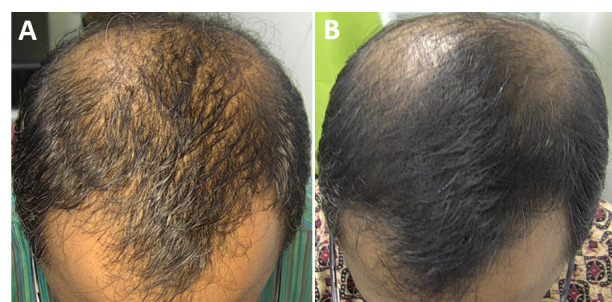
Androgenetic alopecia, male patient: scalp before (A) and after 14 sessions (B), 4-month follow-up.
Protocol: In-clinic 675-nm red-light laser, 14 sessions.
Image: Chandrashekar BS et al., JMIR Dermatol (2024), Figure 1 · CC BY 4.0 · Source ↗ · doi:10.2196/60858
Individual results vary. Shown unaltered, as published by the source.
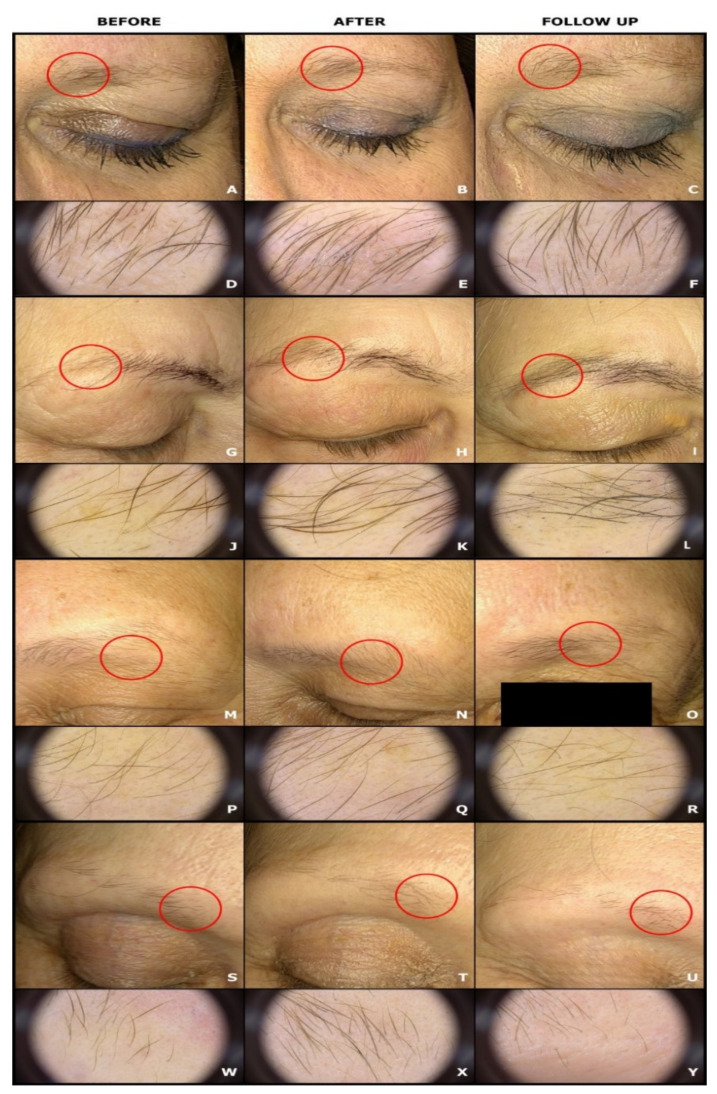
Eyebrow loss in frontal fibrosing alopecia: clinical and trichoscopic images before, after 10 LED irradiations, and at post-treatment follow-up (thicker hairs after treatment; partly reduced again at follow-up).
Protocol: LED therapy, 10 irradiations.
Image: Gerkowicz A et al., Sensors (2021), Figure 1 · CC BY 4.0 · Source ↗ · doi:10.3390/s21175981
Individual results vary. Shown unaltered, as published by the source.
References
- Avci P, Gupta GK, Clark J et al. (2014). Low-level laser (light) therapy (LLLT) for treatment of hair loss. Lasers Surg Med. PubMed 23970445 · Free full text
- Lanzafame RJ, Blanche RR, Chiacchierini RP et al. (2014). The growth of human scalp hair in females using visible red light laser and LED sources. Lasers Surg Med. PubMed 25124964 · Free full text
- Perez SM, Vattigunta M, Kelly C et al. (2025). Low-Level Laser and LED Therapy in Alopecia: A Systematic Review and Meta-Analysis. Dermatol Surg. PubMed 39404126
- Maghfour J, Mineroff J, Ozog DM et al. (2025). Evidence-based consensus on the clinical application of photobiomodulation. J Am Acad Dermatol. PubMed 40253006